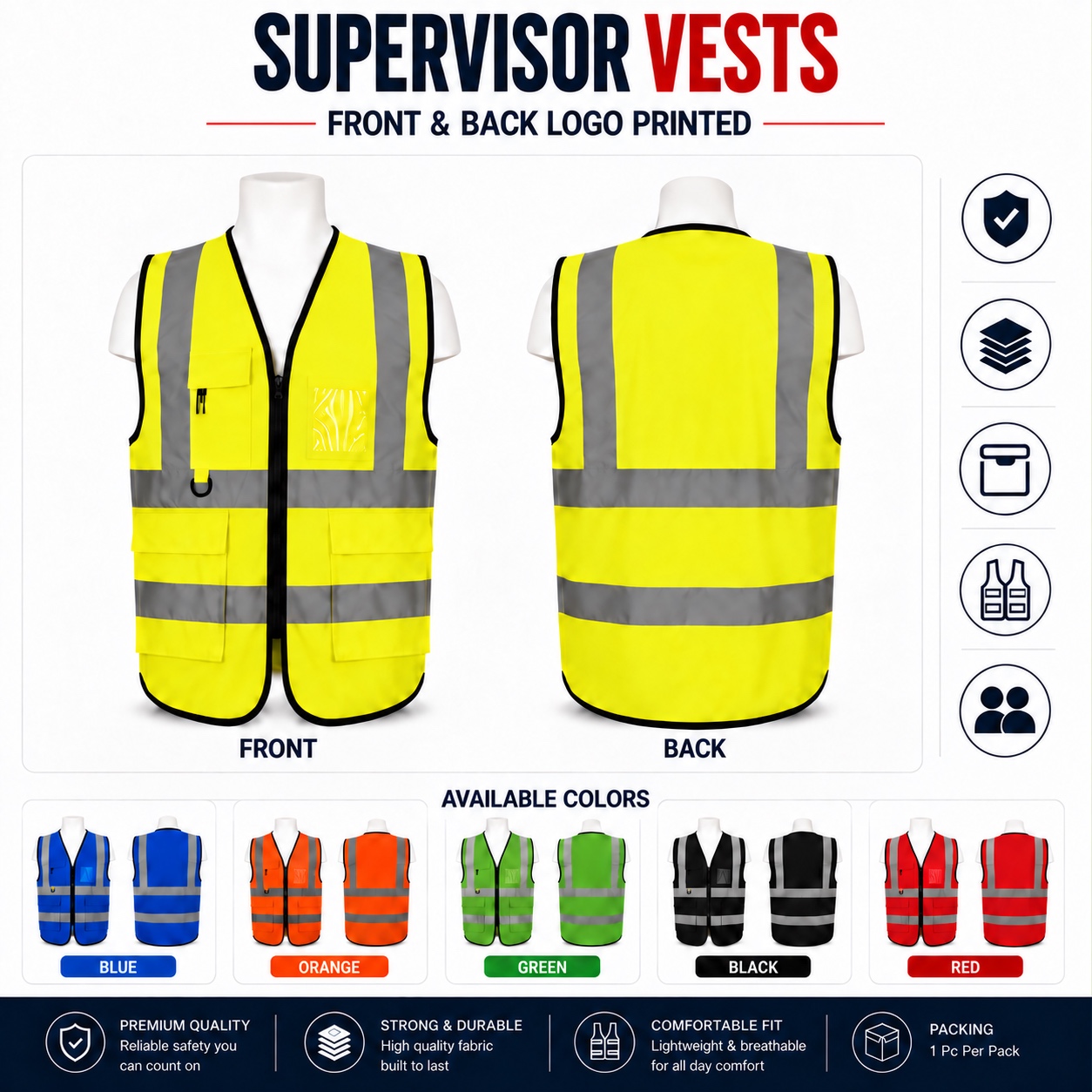
When a site requests branded safety vests, colour and logo size are only part of the specification. Procurement also needs to know which garment the safety team requires, which sizes will be worn and whether the proposed branding is suitable for that product.
A request for “orange vests with our logo” can produce quotations for very different items. Before comparing prices, agree a short written brief with the person responsible for site safety.
This guide is a purchasing checklist. The required protection must come from your project's risk assessment and applicable site requirements; this article does not approve a particular vest for a task.
1. Ask for the site requirement before choosing a style
Record where the vest will be used, which roles will wear it and whether work takes place around moving vehicles or in low light. Ask the safety team to specify any required standard, edition, class, colour and garment configuration.
The UK's Health and Safety Executive advises selecting high-visibility clothing with regard to the risk, lighting, task, fit and compatibility with other PPE. These are useful selection principles, but HSE guidance is not a statement of UAE law. Read HSE's high-visibility clothing guidance.
A visiting supervisor and a worker carrying out a different task may have different requirements. Job titles alone should not determine the level of protection.
If your brief is incomplete, request product options and supporting information for review. Avoid approving an item simply because it looks similar to something previously used.
2. Separate catalogue descriptions from technical specifications
Terms such as “general,” “supervisor,” “engineer” or “executive” can describe a catalogue range or feature set. They do not, by themselves, establish a certified visibility class.
Likewise, a photograph showing bright fabric and reflective-looking strips is not evidence of a particular standard. Ask for the exact product reference, label information and relevant manufacturer documentation.
Where ISO 20471 is specified, remember that its scope includes colour, retroreflection, material areas and material placement. Those are properties of the garment design, not just the presence of a strip of reflective material. See ISO's official description of ISO 20471:2013.
Match the supplied evidence to the actual model and size range being quoted. Have your safety reviewer resolve any mismatch before the purchase is approved. A brochure covering a whole brand is not a substitute for identifying the exact item.
3. Build a quotation line that can be compared
Use one clear line for each distinct product. Include:
- Product or manufacturer reference
- Required colour and site specification
- Required standard, edition and class, where specified
- Fabric or mesh construction
- Closure type
- Pocket and identification-holder requirements
- Size quantities
- Proposed logo positions and dimensions
- Required supporting documents
Keep alternatives on separate lines. A supplier should identify a substitution rather than quietly replacing one model with another because it shares the same colour.
The Xpertone safety-vest catalogue is a starting point for comparing designs. Confirm each shortlisted product's suitability and documentation against the written brief before ordering.
4. Check fit over the clothing actually worn
Try the shortlisted vest over the work shirt, coverall or other clothing used for the role. Check that the closure works as intended and that the vest allows normal movement without inappropriate loose material.
Ask wearers to check access to essential items such as their identification card. Review how radios, straps or other equipment interact with the garment. The safety team should consider the complete arrangement rather than approving each item in isolation.
HSE notes that loose garments can create snagging concerns in some environments and that PPE worn together should not interfere with other PPE. HSE guidance on fit and compatibility.
Record confirmed sizes by product reference. Do not assume the size split for a fitted work shirt will automatically be the correct vest size split.
5. Review logo placement before customisation
Send the logo together with its proposed size and position. Ask the manufacturer or supplier to confirm which areas can be branded and whether the proposed method and coverage are permitted for the exact garment.
Because high-visibility specifications can depend on material area and arrangement, our practical recommendation is to review the completed branded design rather than relying only on the unbranded product description. This is a purchasing inference from the scope of ISO 20471, not a declaration that a particular customisation passes the standard.
Do not approve artwork that covers reflective bands or assume that any empty-looking panel can accept an unrestricted logo. If the permitted area is unclear, pause the artwork approval and obtain product-specific confirmation.
For Arabic and English company names, check spelling and readability on the final proof. Keep the garment reference, artwork revision and approved dimensions together so a reorder can reproduce the same specification.
6. Consider heat without relaxing protection requirements
For teams working in warm UAE conditions, garment comfort matters during selection. Compare suitable options with the safety team and ask wearers for feedback on the complete clothing arrangement.
Some PPE and clothing combinations can add to heat burden. NIOSH advises considering the PPE, work rate and environmental conditions when addressing heat exposure. A lighter-looking vest should never be treated as a complete heat-stress control or as a reason to omit required protection. NIOSH guidance on PPE heat burden.
This purchasing review should support the employer's wider heat-risk arrangements. It does not replace them.
7. Confirm care information and receiving checks
Request the manufacturer's care and use instructions with the order. Ask how the applied logo should be maintained and have any conflicting instructions resolved before production.
At receipt, compare the delivered items with the approved reference, sizes, colour, label information and artwork. Check a representative selection from the order rather than checking only the carton label. Escalate visible damage, incorrect branding or an unexplained product substitution before issue.
Keep the approved specification and supporting documents available for future orders. Set up inspection and replacement arrangements using the manufacturer's instructions and the site's safety process, rather than an invented universal replacement interval.
A practical enquiry to send your supplier
Use this structure when preparing your request:
“Please quote for the attached size quantities of the specified vest. The site requirement is attached. Include the exact product reference, available supporting documents and care instructions. Branding is required in the positions and dimensions shown in the artwork. Please confirm permitted logo application for this product and identify any alternative separately. Confirm the total quotation and proposed production and delivery schedule.”
Attach only the information needed for the quotation and use an approved company logo.
Discuss your order with Xpertone
Send the garment or vest reference, quantities, sizes and branding requirement for a clear quotation and production review.
Request a quoteFrequently asked questions
Is an executive vest automatically a higher protection class?
No. A catalogue role label is not proof of a technical class. Check the exact product information against the site's requirement.
Does adding reflective tape prove a uniform meets ISO 20471?
No. The standard addresses several garment properties, including material area and placement. Product-specific evidence is needed to support a claim of conformity.
Can our company logo be applied anywhere on the vest?
Get confirmation of the permitted method, position and coverage for that product before approving the design. The available panel space alone is not sufficient guidance.